The Plight of the Purple Rainbow Ant: On Creativity and the Multitudinous “Self”
Recently, I have begun to understand the power of noticing and mental presence, both within myself and my immediate surroundings. Once you set your eyes to the unfamiliar, dropping your ego in favour of open curiosity to everything, the world will present you with treasures in the most unexpected places. It is this curiosity and interest that has driven me to begin my blog, though I must tread carefully.
I have found over the last few years, I have tried to define myself and my interests within a set group of activities, a set genre, a set aesthetic. For example, I am interested in the written word, poetry, blogging, fiction and non-fiction, is having/enjoying oil pastels, sewing, or crochet, a waste of money? Shouldn’t I be focusing on one area only and being a “writer”, “poet”, “visual artist”? Should I be “cottagecore”?, “whimsical twee”?, “fairycore”? I find this way of thinking to seriously restrict me within my creativity, though that hidden undercurrent of judgement rushes through me constantly, unconsciously. To consistently meet myself with curiosity to discover what makes my brain jump for joy, has led to a recent keen interest in the Purple Rainbow Ant.
Before continuing, I would like to say a big thank you to everyone in my life that has listened to me yap about these beautiful little creatures and the injustices they face to no end. Over the last 5 months, if you have had the pleasure of living with me, staying with me, sitting next to me at a party, talking to me over the phone, being my coworker, manager, or even being my psychologist, then you have already heard in extensive detail about the Purple Rainbow Ant. Though if you have not experienced this pleasure first-hand, this article will quickly bring you up to speed!
After finishing with said psychologist one afternoon, I ambled my way down to a local park (which will not be named, for reasons yet to be revealed). Admiring what I think to be the straggly bark of a Monterey Cypress, I noticed flashes of pink and purple trailing up and down the trunk. Brightly coloured, almost glowing ants, just bigger than my thumbnail, were walking back and forth, their abdomen’s capturing the sunlight. I soon brought Ian over to see the trail as well, and we traced their path to a mound of gravel and small stones in the middle of said park. After quickly researching their nest shape and material, and their colour, I surmised them to be a nest of “Purple Meat Ants”. I will also add here that for the remainder of this article, I will be referring to them not as “Purple Meat Ants”, their more common name, but as Purple Rainbow Ants (a translation of their scientific name Iridomyrmex purpureus) which I will also explain later.
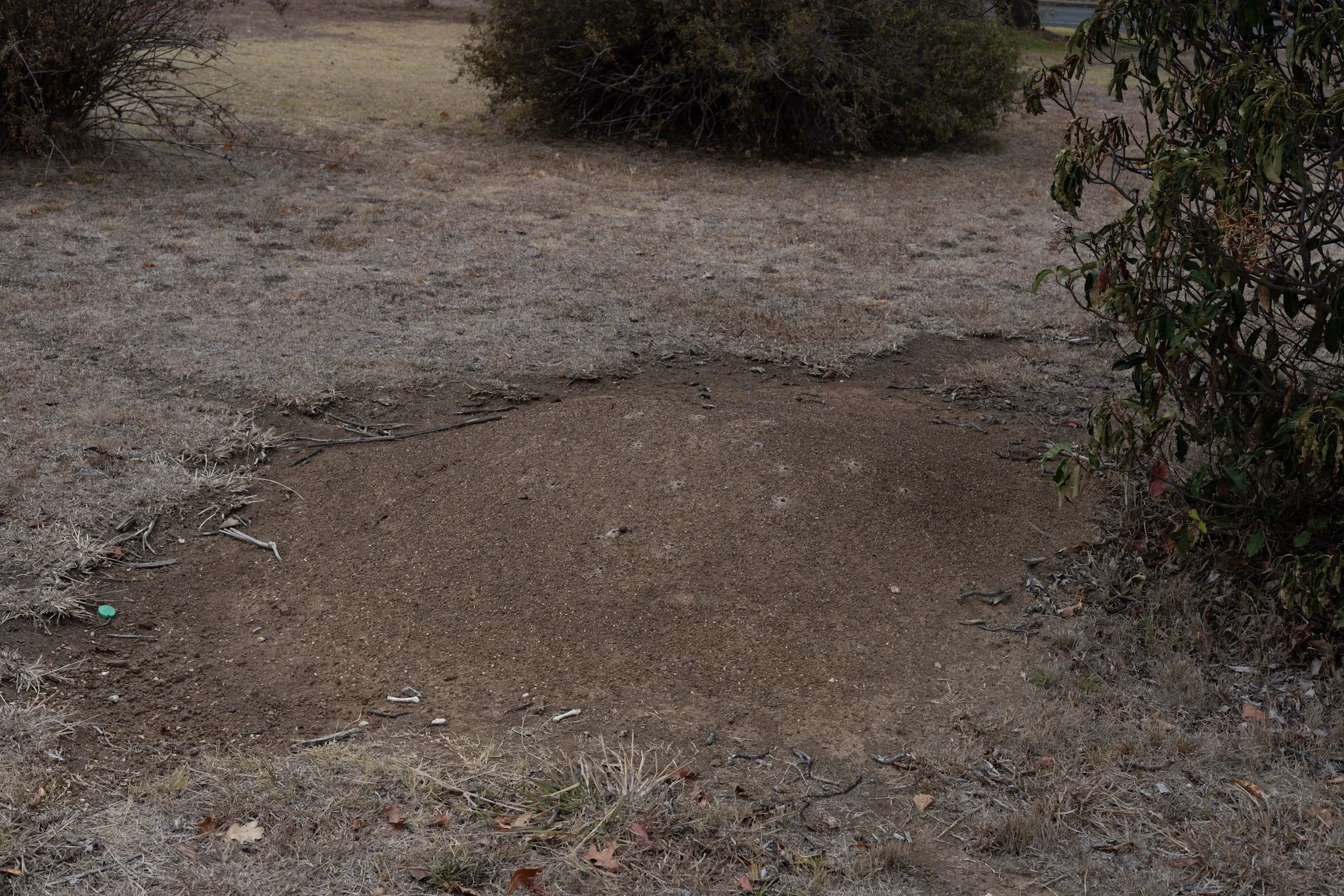
Purple Rainbow Ant nest, not the exact one I first noticed but another found around Armidale. Thanks to Ian for the photos for this piece!
The Purple Rainbow Ants; What We Know So Far
Their beautiful pink and purple colour drew me to research their behaviour, habitat, diet, taxonomy, anything and everything written about them, in the hopes of writing a post for my blog.
These ants are endemic to Australia, though only the mainland (sorry Lutruwita/Tasmania, you miss out on all the fun!), and build their large nest mounds using pebbles, dirt, and rocks in warm and open areas, clearing any vegetation. They are a polydomous species, meaning that multiple nests can be connected by cleared paths, and cover a large area of ground, and can even have multiple queens. On these paths, you can often see the ants carrying dead ants, insects, seeds, and other bits of decaying material.
The Purple Rainbow Ant is a crucial component of the Australian ecosystem, acting as scavengers of dead and decaying animals. With the ability to clear dead animals down to only bones in weeks, farmers will often leave their dead livestock near to a nest, allowing the ants to handle the dirty work for them. I was able to identify another Purple Rainbow Ant nest on my walk home from town, when I noticed what seemed to be a marinated chicken wing that had been left on the edge of a pathway. Countless ants covered the wing, stripping it down. But in doing so, the ants were keeping the park safe, by removing the potential hazard (disease causing pathogens etc).
Quick, low quality video of said chicken wing!
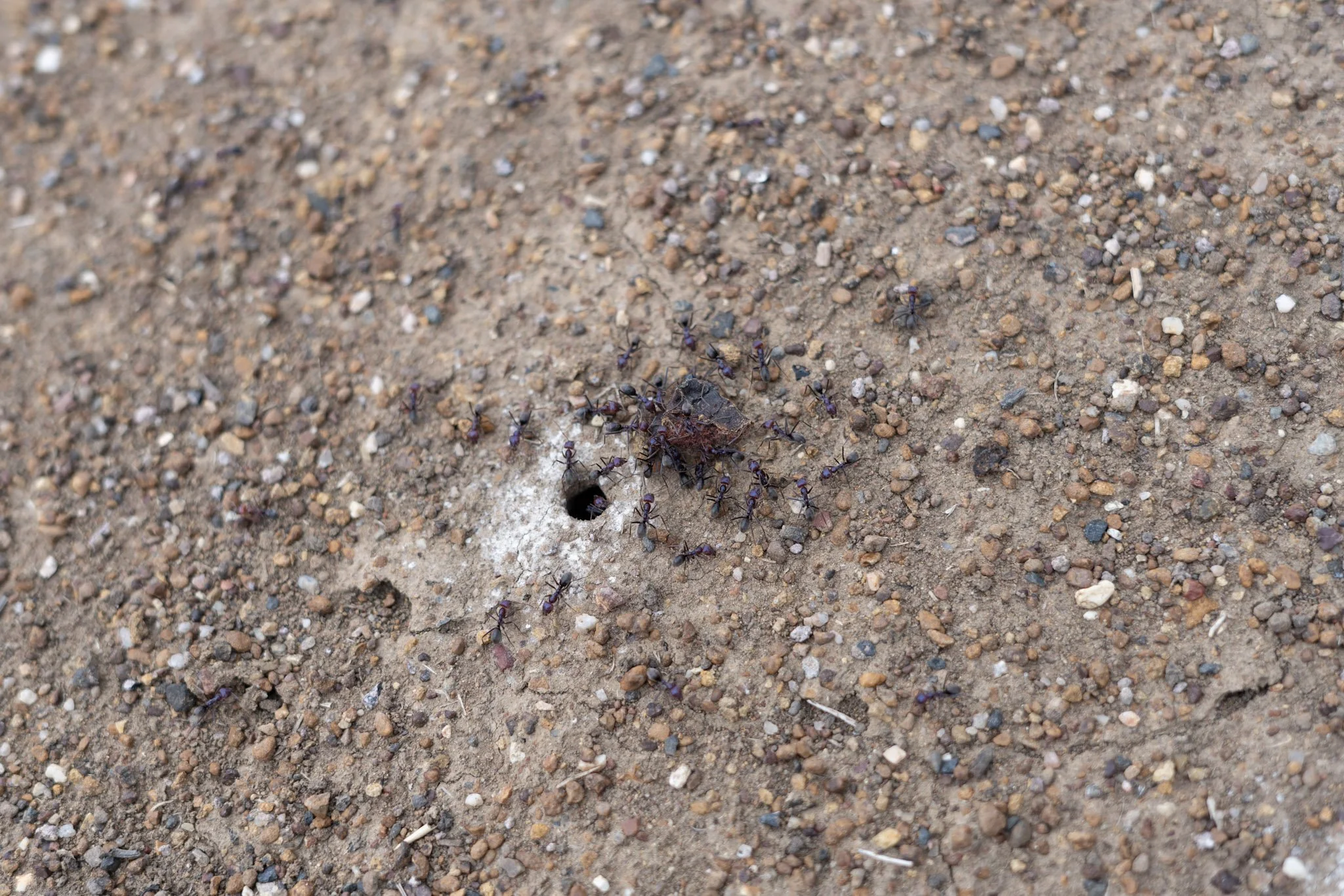
Hard at work! These purple rainbow ants carry scavenged food to their nest opening, thanks to Ian for the photo!
Gimme Gimme! - Ritualised Fighting and Nestmate Feeding
The ants are also quite gentle with each other, and engage in ritualised fighting, rather than outright aggression when faced with an ant from an unfamiliar nest, most often around a food resource. Fatal encounters between the Purple Rainbow Ant are extremely rare. A 1982 study from Monash University by Ettershank and Ettershank, and a 2020 study by Han and Elgar discuss the ant’s ritualised fighting behaviours, which follow a similar pattern to that of feeding habits between nest-mates.
The Purple Rainbow Ant, when feeding others within the nest, will begin to engage in antennation; the tapping of each other’s heads with their antennae. The ant seeking food will begin to drum their antennae upon the sides of the donor ants head, giving the donor ant the opportunity to either block said drumming with their own antennae (signalling that they do not wish to feed them, or that they have no food to give), or to lower the front half of their bodies, opening their mandibles, and producing a droplet of food for the recipient ant to then take.
Quick Purple Rainbow Ant communication
This order of behaviours is extremely similar to the stages of ritual fighting; The antennation stage, the drumming of each others heads, is the same, though when neither ant lowers itself or blocks the tapping, this antennation becomes more intense, and eventually sees the ants’ mandibles begin to open. When neither ant yields, they will then both raise themselves onto their back legs, and begin a kind of front-leg boxing, and then grab each other with their mandibles. At this point, again, if neither ant detaches and submits, they will continue this grapple until each ant is side by side to one another, legs back on the ground, mandibles still locked, where they then begin to move in a circle. While circling and locked, the ants begin a kicking motion with their back leg, though this kick is outwards and away from the opposing ant. These stages generally last a few seconds each, with most ritual fighting ending by the cancan kick stage, which sees the ants detach, the one lowering first being the ‘loser’, groom their antennae, and dawdle away to continue searching for food. Below is a diagram from the Ettershank and Ettershank paper that shows the stages visually.
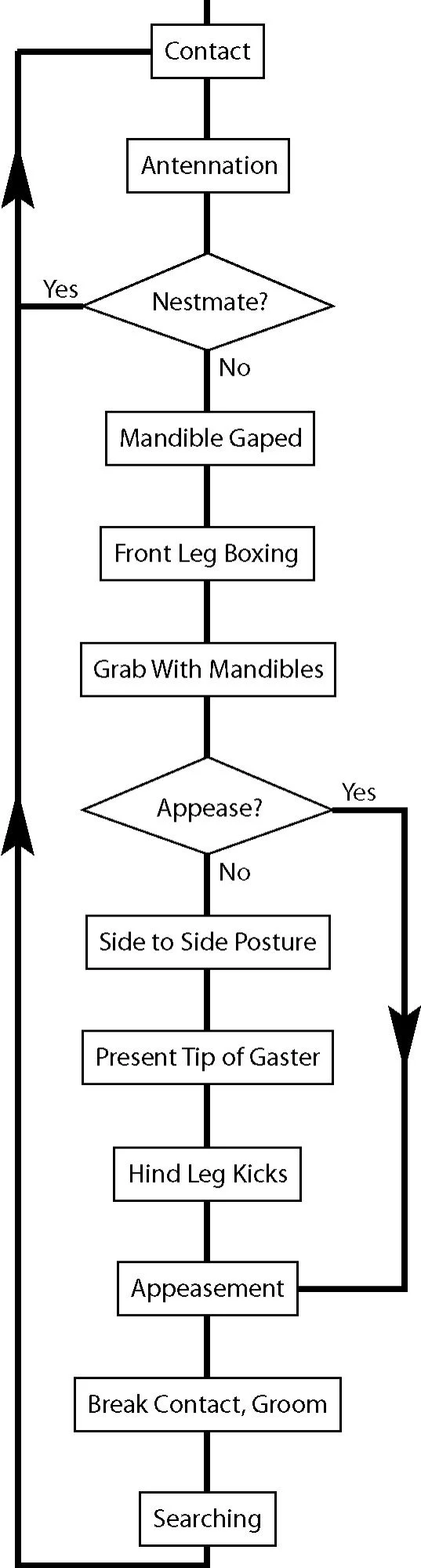
Ettershank & Ettershank, 1982.
Okay, and? So what?
The above information was the first area of interest for me with these ants. However, as I was reading, I began to notice it mentioned that the Purple Rainbow Ants were extremely aggressive, and capable of spraying acid from their gasters (abdomens) when threatened. Wikipedia, Museums Victoria, the Australian Museum, the Atlas of Living Australia, and even the ABC in a science podcast episode all discuss how when an individual approaches these nests, the ants will swarm out en masse, and aggressively attack said threat, inclusive of biting and spraying, also citing that the nests have a strong chemical smell (some sources saying of formic acid specifically) to deter said threats. As I was reading this, I felt that it was a heavy contrast to the ants I had come into contact with. Both myself and Ian, and friends too, have come to the different nest sites I have found around Armidale to take photos, track their movements and pathways, and at no point were we aggressively swarmed, bitten, sprayed, or otherwise attacked. Ian has even stood on a mound, in order to set up his camera’s tripod to take the photos for this blog post. And even within this scenario, though one or two had climbed onto his foot, none had bitten or sprayed him, nor was the area surrounding any of these nests smelling strongly of any acid.
I traced the references that I listed above, to try and find the source of this information. I spent many days reading any available online information, focusing on peer-reviewed journal articles, anatomical or behavioural studies, or even first hand encounters. Wikipedia, for example, states;
Meat ants lack a stinger, but they can induce irritating bites and secrete a defensive fluid from the end of their abdomen.
The Wikipedia editors then use each of these references for the above statement;
"Iridomyrmex purpureus (Smith, 1858): Greenslade's Meat Ant". Atlas of Living Australia. Government of Australia. Archived from the original on 26 January 2016. Retrieved 6 February 2026.
This webpage, from the Atlas of Living Australia, states “The worker ants cannot sting, but they can bite and secrete a defensive fluid from the end of their abdomen”. This webpage then only cites Museums Victoria for their information. Following the citation, and going to Museums Victoria’s information webpage, they reference the Atlas of Living Australia as their source of information, a prime example of circular referencing.
"Meat ants (Iridomyrmex purpureus)" (PDF). Department of Primary Industries and Regional Development. Government of Western Australia. 2019. Retrieved 20 February 2026.
This reference is a fact sheet by the Department of Primary Industries and Regional Development by the Government of Western Australia. Released in 2019, it only acknowledges that the I. purpureus will bite aggressively when disturbed, and lists the different insecticides that are effective in killing the nests.
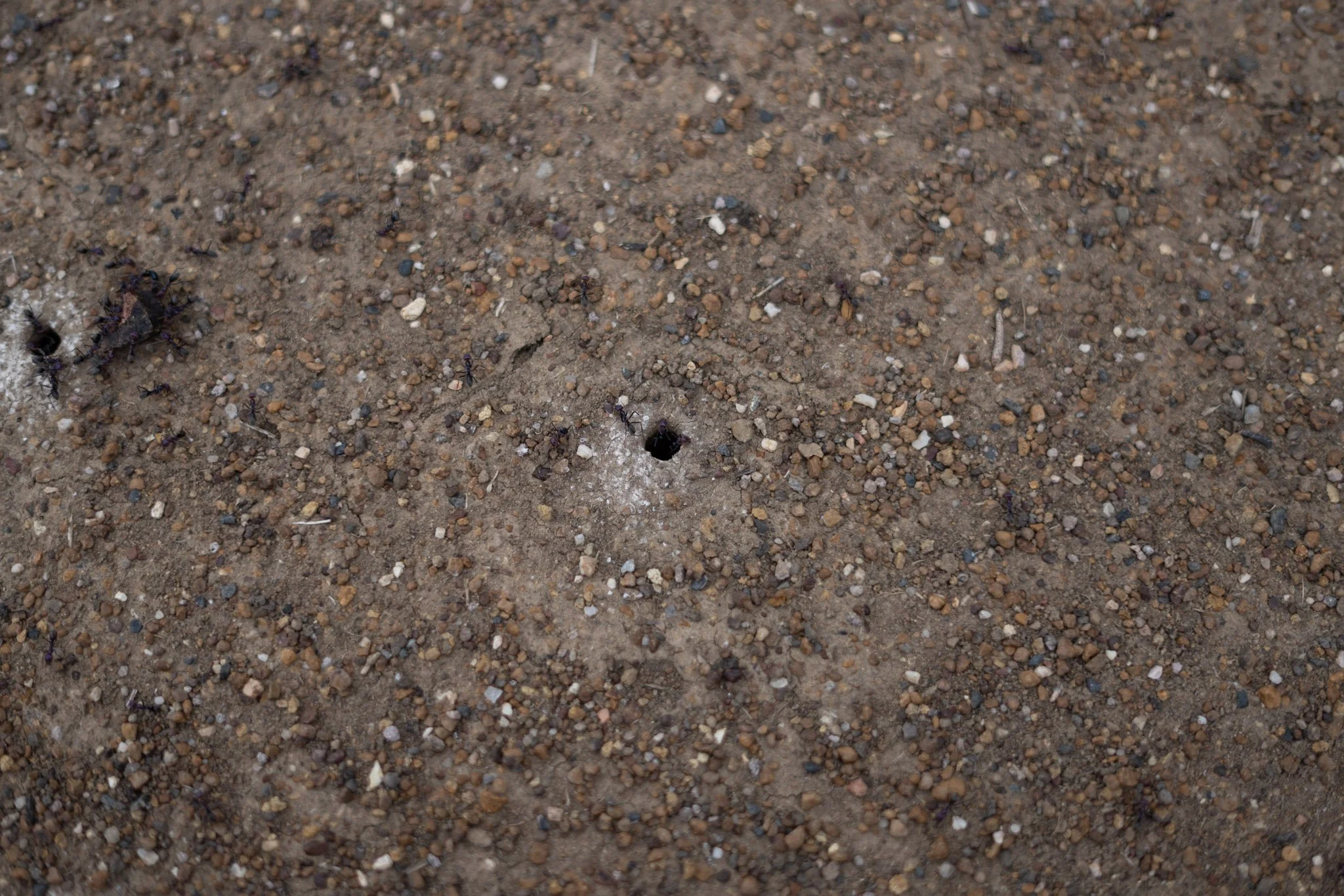
Ants “aggressively swarming us”…, thanks Ian for photo!
After spending many days, including a singular 10 hour straight period, going through any available source of information online on these ants, every single citation in any webpage, journal article, podcast, book, falls victim to circular referencing, except for 2, that I will soon discuss. I have logged these circles in a singular document, though for the purposes of this blog post, I won’t outline everything, but you can see it for yourself through a bit of digging and tracing. Outside of these circles, there are 2 journal articles that have stood out, that I must discuss before concluding this section. These 2 articles are not part of the circular referencing that surrounds this ant's ‘aggressive’ behaviour, but I deduce as being the source of the above misinformation loops.
The first article is from 1985 by Hölldobler & Carlin, titled Colony Founding, Queen Dominance and Oligogyny in the Australian Meat Ant Iridomyrmex purpureus. In my reading, this article is often cited as the source of the “defensive spraying” idea. The entire paper discusses the ability of nests to have multiple queens, and the behaviours surrounding dominance and reproductive rank. The article states;
During independent colony founding, the young queens are exposed to heavy predation. Greaves and Hughes (1974) report that 60-80% of I. purpureus incipient nest chambers were found empty, dug open by ground feeding birds. We too noted heavy predation on foundresses in our study area, especially by magpies and currawongs. However, we never observed bird predation near mature nests, which are well defended by large numbers of very aggressive workers, equipped with powerful defensive secretions (Cavill et al. 1956).
The article is behind a paywall, and without an institutional login, would cost money to access. Hence, for accessibility, AntWiki summarises the Hölldobler & Carlin paper by stating;
Meat ant workers are extremely aggressive, biting enemies and spraying them with poisonous secretions from their pygidial glands. Hölldobler and Carlin believe that the queens protected in this manner are the ones fortunate enough to settle near their natal nests, so that the foundresses are also likely to be absorbed into the mother colonies to become supernumerary queens.
By comparing the above, we can see how the Purple Rainbow Ants behaviour has been twisted from a defensive secretion, to a poisonous secretion that is sprayed, due to what is probably an accident when summarising, but perpetuated by academic paywalls. At no point in the Hölldobler & Carlin paper is a pygidial gland even discussed.
We then take a look at the second article I wish to mention, which is the 1956 paper cited by Hölldobler & Carlin, Chemical Ecology of the Meat Ant, Iridomyrmex Purpureus Sens Strict by Cavill et al for the University of New South Wales. This article takes inspiration from papers from 1922 to 1952 that show the ability of some ants within the Formicinae subfamily (which our Purple Rainbow Ants are not a part of) to secrete formic acid, for attack or defense, and possibly for chemical trails and scent-marking. The article then continues with the aim of determining the individual chemical makeup of ants outside of the Formicinae family, including Iridomyrmex. detectus (the previous name of the Purple Rainbow Ant), I. conifer, I. nitidus, and I. humilis.
The Purple Rainbow Ants were collected, stored in pure ethanol, air-dried, added to water, and then crushed. The remains were subjected to different chemical tests, with the researchers determining that the ants do indeed have a unique chemical signature. At no point in this paper, however, is the chemical signature from the mashed Purple Rainbow Ants identified as being a defensive or offensive secretion.
Overall, through all of my reading on these ants, I cannot find any first-hand observations of the use of a defensive secretion or spray, an anatomical study into the ants very biology to determine a gland, sac, or similar to store such defensive liquid, or any paper or article that demonstrates this behaviour or aggression, at all, inclusive of swarming out of nests and spraying/wiping acid/poison. My first hand experiences with these ants have always been amicable, and myself and anyone in my life that I have taken to a nest, including Ian setting up a tripod by standing on the very nest itself (in sandals!) and having a few crawl onto his feet, have never been sprayed, bitten, or swarmed.
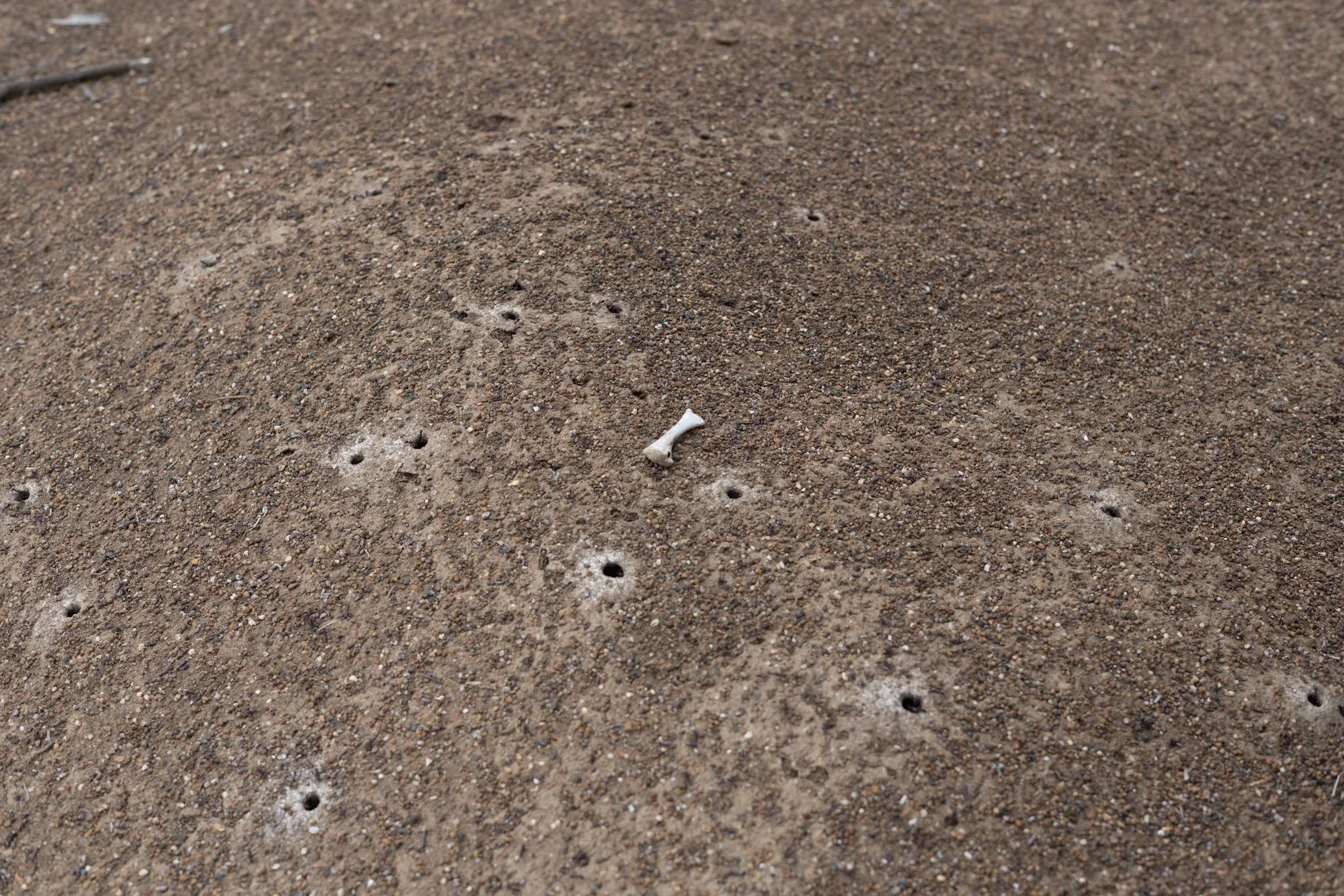
Bone remains left upon their nest mound! Photo thanks to Ian!
Where to Next?...Bring it On.
As I have mentioned earlier, governments, farmers, and local councils aim to eradicate this native, scavenging ant, and provide information on the best ways to kill their nests, despite how helpful they are in processing livestock and other dead animals. Many think that the ants pose an aggressive threat, though this perceived threat, according to my reading, is entirely baseless and due to circular referencing, badly worded summaries, and conclusions being pulled from places where none were to be found.
Having gone through these papers and spending hours researching these ants, Ian and I have become inspired to conduct our own research, with Ian designing the study. At this stage, we are collecting data on the location of different kinds of ant nests around Armidale.
In all of this, my curiosity that I discussed at the beginning of this post has not only led to my noticing of the ants, my research into their behaviour, but also influenced my approach; I don’t want to be correct in my hypothesis, I want to know, even if that means that they do in fact spray acid, cover you in bites, and attack in a swarm of pink-purple aggression. I have now realised the value of such curiosity. My interests, though varied and assorted (which I now understand to be an aspect of my neurodivergence) can lead me to all different topics and places, and could perhaps one day make a bigger difference in the world. Maybe we’ll find out that they don’t spray, and the overarching attitudes to these ants shifts to one of respect for their role in the ecosystem, resulting in a healthy co-existence. Maybe we’ll find out that they do, and we add to a body of research in an area that is improperly handled otherwise.
Dampened curiosity is a dampened self, through all of one’s facets.
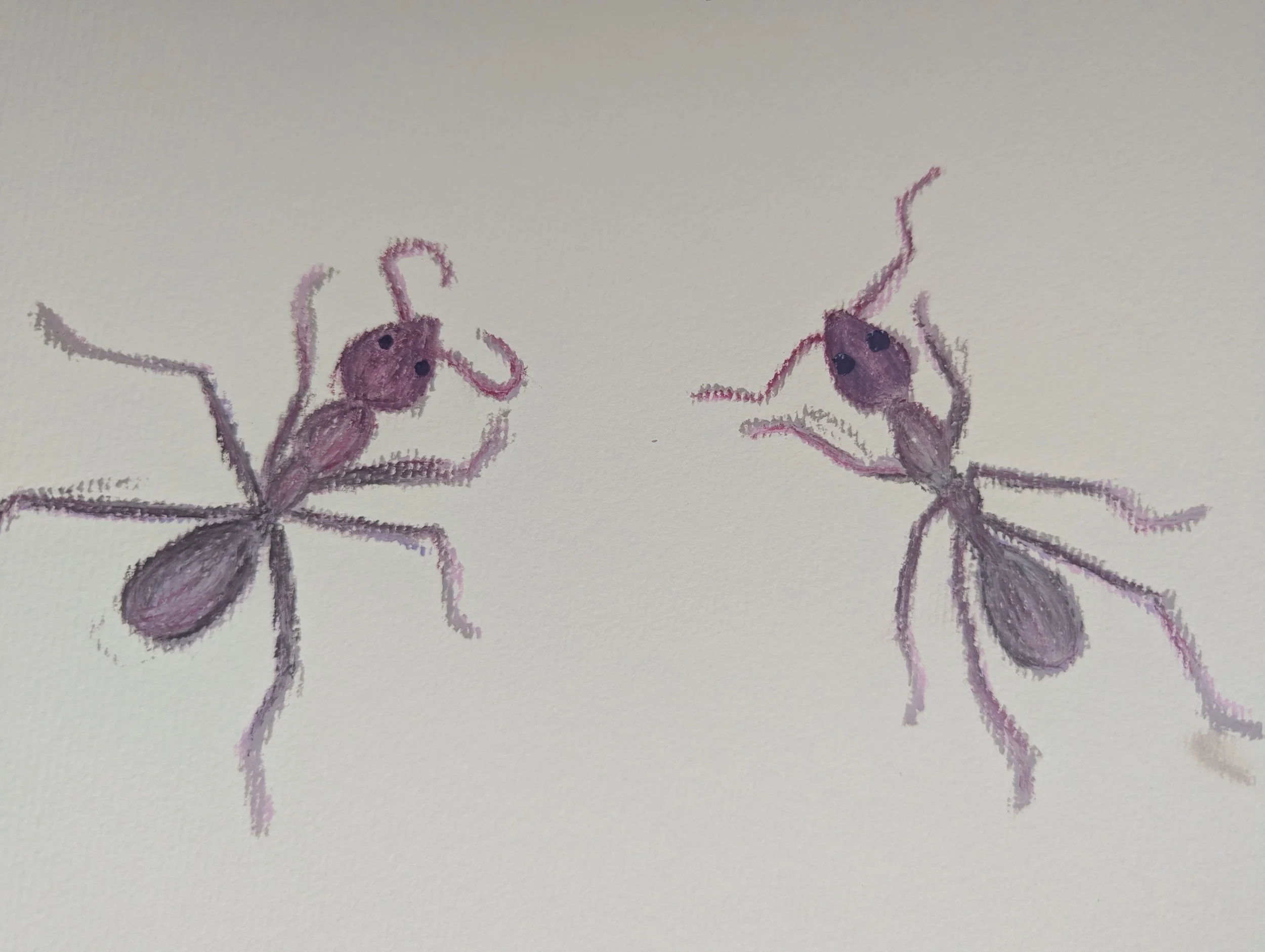
Purple Rainbow Ants, oil pastel, by Sierra
I will continue to post any updates on my blog surrounding this topic, and if you know anything about the ants, or have personally experienced an attack or aggression, or had a neutral or positive interaction, please contact me using the email below so I can add it to our research.
