Honeyeaters, Silvereyes, and Dollarbirds, Oh My! Noticing Migration Patterns in Armidale
Last autumn and into winter, I was struck down so ill I spent a majority of my time sitting on the front porch, breathing and watching the world shifting around me. During this time, I noticed a family of Yellow-Faced Honeyeaters, Caligavis chrysops, had taken residence in our arborvitae tree. I had never noticed these honeyeaters in the last 4 years of living in Armidale, nor during my time as a teen in the Blue Mountains. By the end of winter, I hadn’t noticed, but they had left the tree.
Into spring and summer, whilst I didn’t notice their departure, I did note the arrival of another new bird; blue-green, bright orange bill, and huge white spots underwing, visible as they swooped and spiralled high overhead. I had never seen a Dollarbird, Eurystomus orientalis, though quickly learnt that they are part of the “roller” family due to their acrobatic talent, and that they were only here for the summer, returning to Indonesia and New Guinea as the cooler months set in.
Now that autumn is in full swing yet again in Armidale, the Dollarbirds have packed their suitcases and taken flight, and the Yellow-Faced Honeyeaters are back! This time, not nesting in the arborvitae, but helping themselves to our fig tree!
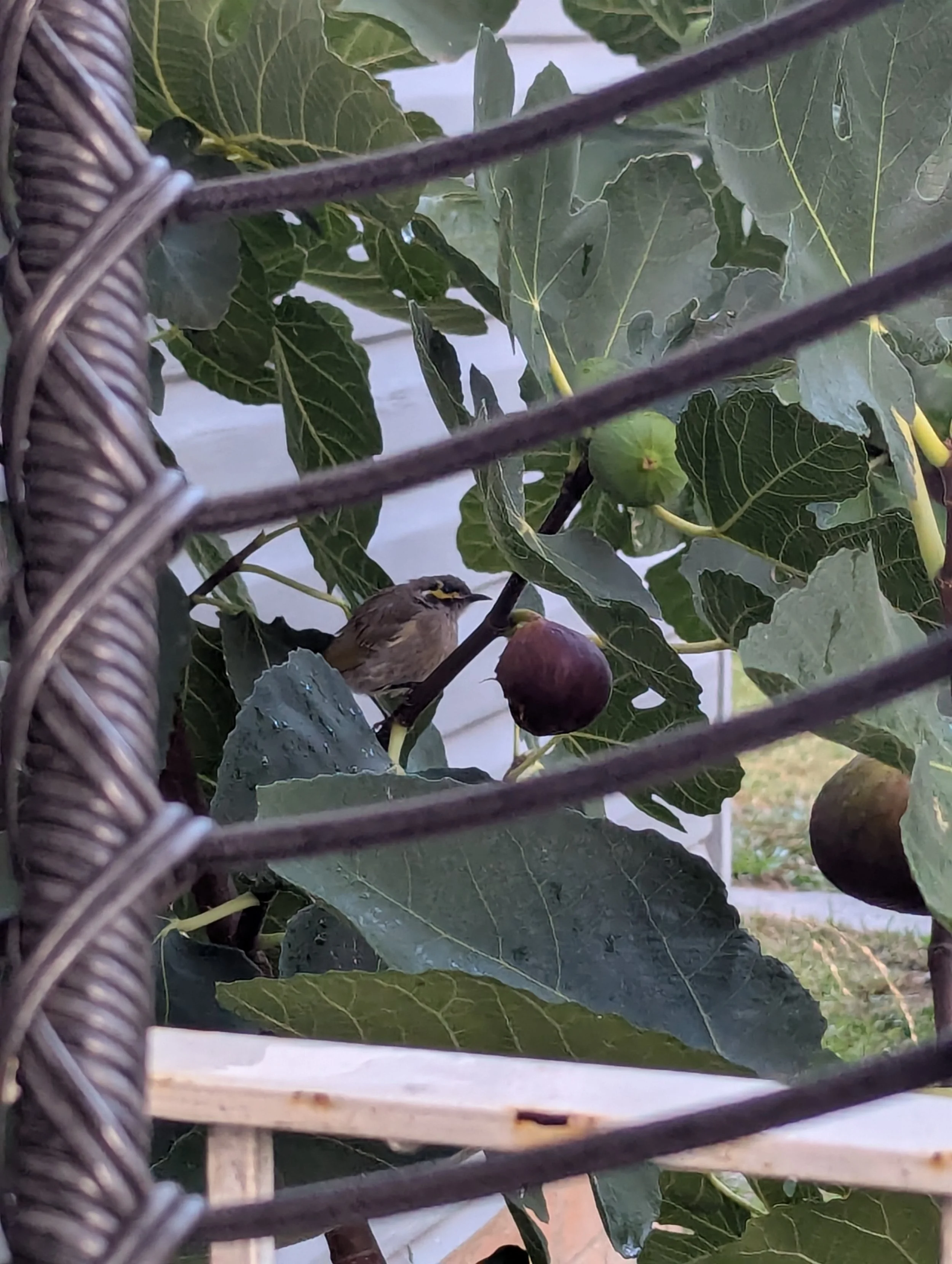
Yellow-Faced Honeyeater eating our figs!
Caligavis chrysops
A quick google search has confirmed my thinking; Yellow-Faced Honeyeaters migrate north around Easter each year, travelling up along the Great Diving Range as part of the great “Honeyeater Migration” which sees thousands chasing the warmth of the northern regions of Australia. Along with the Yellow-Faced Honeyeaters, Emily Mason with Landcare also notes that Scarlet Honeyeaters, Eastern Spinebills, Noisy Friarbirds, Red Wattlebirds, and Silveryeyes join the caravan.
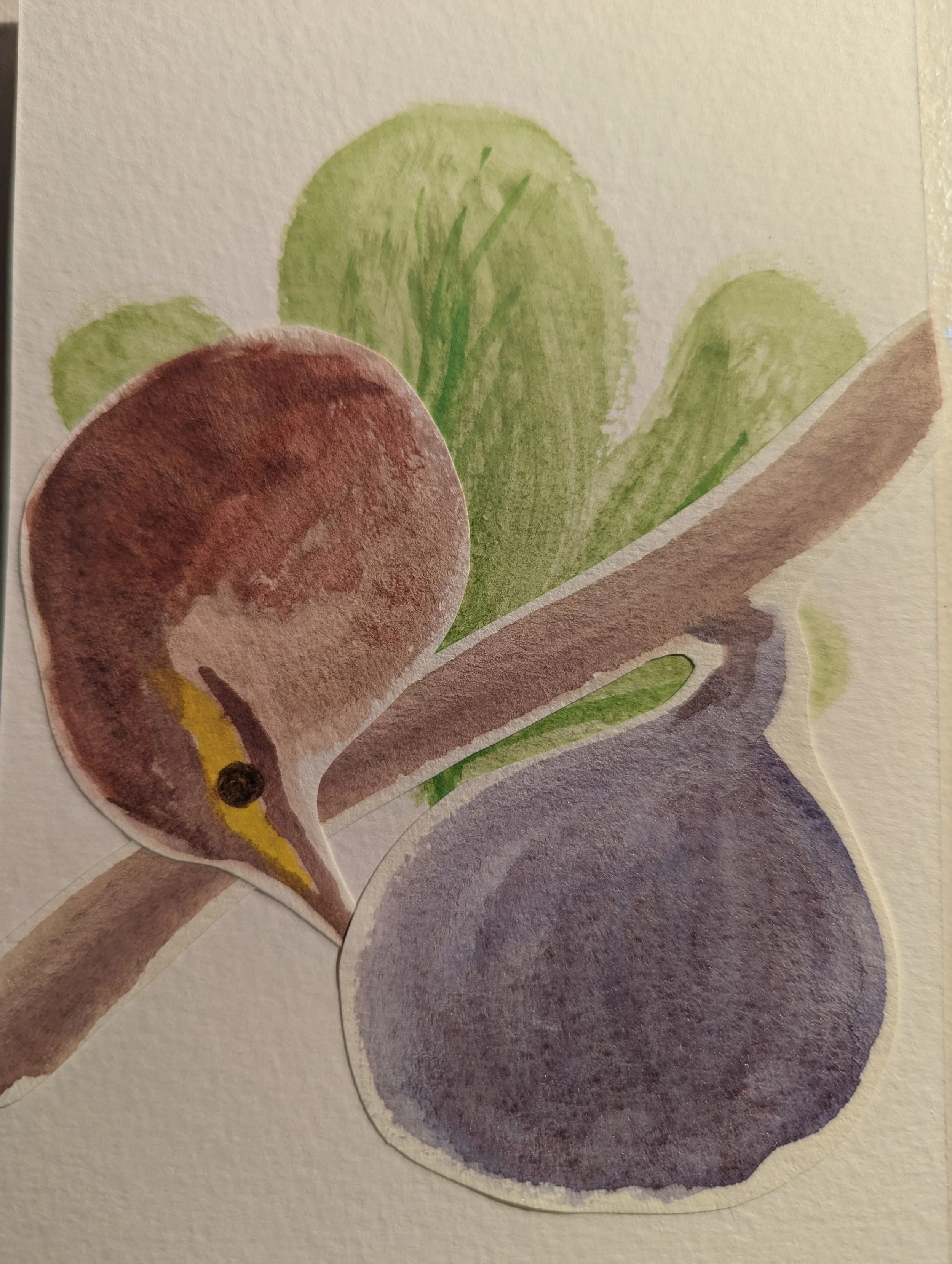
My watercolour painting of a Yellow-Faced Honeyeater enjoying a fig
Reflecting on this, I realise that I too have been in awe of the Silvereyes, Zosterops lateralis, flitting around in groups between the reserve near our house and the trees lining our street. They move in loose groups from tree to tree, their silver eye-ring in stark contrast with their olive and buff bodies, and I often see them also eating our figs!
Silvereye in the Fig Tree
Researching Zosterops specifically, I loved Matt Ross’ (@matt.rossella on Instagram) Blurbs episode late last year on this “Great Speciator”! I won’t spoil the episode, but these little birds have a long history of, let’s say, making the best of a weird situation! Anyhow, there are two subspecies of Zosterops that you can find in Armidale; The Zosterops l. laterialis, and the Zosterops l. cornwalli, with the former travelling from Tasmania, and the latter travelling from Southern NSW/Victoria instead. To differentiate the species proves quite tedious, with most researchers measuring weight, wing length, tail length, and body length to surmise which is which, and even then, this does not account for inter-subspecies mingling!
I am so fortunate to have spotted these birds’ arrival in my yard and street, and to have access to information about their travels at my very fingertips! For now, I welcome their cheeky theft of my figs, a juicy and well-deserved reward considering the distances they have travelled to get here! It really is the least I can do for these little guys!
P.S., The Silveryeyes and Yellow-Faced Honeyeaters aren’t the only ones enjoying our figs!!
Not sure this Strepera graculina has had to travel as far for this sweet treat!
